

[read time: 5 minutes]
As a Type A gal and an Enneagram 7, I have a spreadsheet for everything. I’m not even joking. Metric tracking helps me to feel in control of my finances while tackling student loan debt.
I’ve been using YNAB (You Need a Budget) since high school. But, I really started using it seriously in 2024, when I committed to sticking to a budget. It’s one thing to set up a budget. It’s another thing entirely to actually use it.
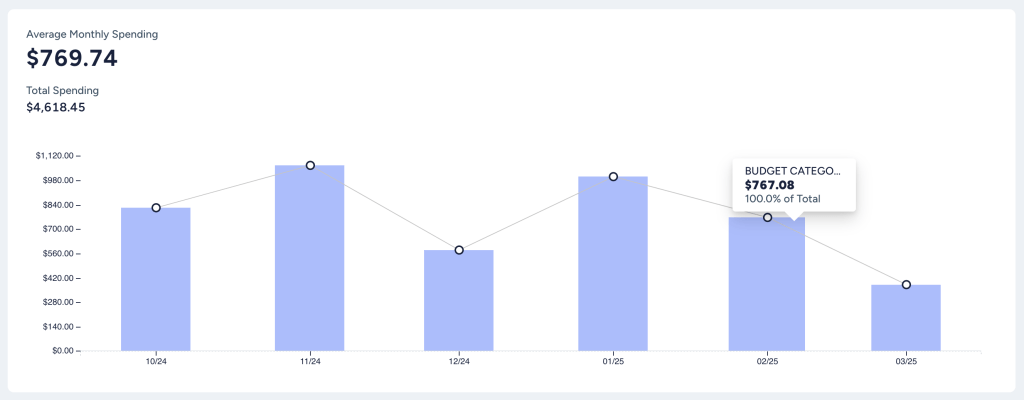
One thing I particularly enjoy about YNAB—though it’s not always 100% accurate since it relies heavily on categorizing transactions correctly—is the “Reflect” feature. This allows you to see spending breakdowns, trends, income vs. expenses, and even your net worth based on how you budget! We use this section to track our spending habits and adjust our budget categories to better align with our goals.
YNAB allows my husband and me to implement a zero-based budget, which encourages you to “use” every penny of income. Another way to put it: every dollar you earn gets a job—whether that’s paying a bill, saving, or grabbing a cup of coffee. The ultimate goal is for income minus expenses to equal zero.
I find this type of budgeting, especially when tackling a large amount of student loan debt, makes the process feel like a game. It puts me in a mindset of how can I lower my regular expenses so more of my money can work for me? Think: making extra loan payments, increasing 401(k) contributions, or setting aside more for a future trip.
I thought it would be fun to document what our YNAB budget currently looks like as we start this journey. If you’re familiar with Refinery29 Money Diaries—that’s the vibe I’m going for here.
Occupation: Designer
Industry: Architecture & Urban Planning
Age: 25
Location: Portland, OR
Salary: Combined income of $166,000
Take-Home Pay (Monthly): ~$8,400 after 401(k) & insurance contributions
Monthly Expenses
Rent: ~$1,750
Wifi: $35
Electric: ~$70 (summer/fall), ~$250 (winter/early spring)
Insurance (renter’s, car, and pet): $136.81
Groceries & household items: ~$750
Gas: $120
Auto maintenance & registration: $31
Public transit pass: $75
Phone bill: $40
Subscriptions (Game Pass, Disney+, HBO Max, Spotify, & Netflix): $87.46
Gym membership: $193.84
Oura Ring w/ Natural Cycles integration: $14.69
My Roth IRA contribution: $150
My husband’s Robinhood investment: $50
YNAB subscription: $9.08
Dog food (every other month): $47.49
Dog grooming: $145
Going out with friends: $75
Date night: $75
Eating out: $150
ARE 5.0 exam studying platform: $240
Christmas fund: $133.93
Student loan autopay: $1,769.10
We also have budget categories that aren’t used every month but are there when needed—pet boarding, vet visits, personal care, medical expenses, clothing, gifts, work expenses, gardening (iykyk), fun money for both of us, and a category for things we forgot to budget for.
As for our savings goals, we utilize an HYSA for things such as; an emergency fund, travel/vacation fund, Christmas fund, new laptop fund, future house fund, new car fund, and our moving fund. Contributions vary based on the month and our current priorities. We also both contribute to a 401(k), which we track using YNAB’s investment tracking feature.
If you’ve been keeping track, our monthly expenses total around $6,400, or $4,600 before student loan payments. We estimate actual spending at $6,500 after miscellaneous additional expenses—like a friend’s surprise birthday dinner, a last-minute trip home, or an unexpected vet visit.
That leaves us with ~$1,900/month to put toward extra student loan payments or savings goals. We feel incredibly privileged to have this flexibility, but we’ve also worked hard to get here.
Each month, we decide how to allocate the “leftover” money at our Saturday budget meetings. Sometimes, half goes toward our emergency fund while the other half tackles high-interest debt. Other times, we save for upcoming flights while covering accrued student loan interest.
Our weekly budget meetings look a little different depending on the time of the month:
- First meeting of the month → Focus on non-negotiable expenses
- During the month → Focus on keeping expenses low where possible
- Last meeting of the month → Assess how much extra we can put toward loans.
We also analyze our spending habits to make adjustments. For example, YNAB’s spending trends feature showed us that our grocery costs were climbing. We adjusted in January, and by February, our grocery budget was back on track. Now, if only we could get it as low as it was in December when we spent two weeks at home getting wined and dined by our parents!
I know some people might disagree with how we spend while carrying student loan debt. Could we cut back more? Sure. But I love my gym and go 5-6 days a week for both my physical and mental health. We also love our Sunday routine of watching the latest White Lotus episode or having a cozy date night playing a new Xbox game. These things, and some of our other budget categories, allow us to keep living life and enjoying it!
The way I see it: I’d rather spend 4 years and 5 months paying a moderately aggressive amount and enjoying life than 2 years and 10 months paying an aggressive amount while feeling miserable. Curious how I came up with those timelines? I’ll be writing a post soon about how we built our payoff plan—estimating we’ll be debt-free by August 2029, almost six years early!
[featured image: Nature Background Vectors by Vecteezy]
YNAB offers a free 30-day trial, and if you use my referral link*, we both get a free month! If you pay annually, it breaks down to just $9.08/month—totally budget-friendly.
*This post may contains affiliate links, meaning I may earn a small commission if you subscribe. Most of the time, you’ll also get a bonus, so it’s a win-win!
I’d love to hear from you! What kind of budget strategy do you use?





Leave a comment